
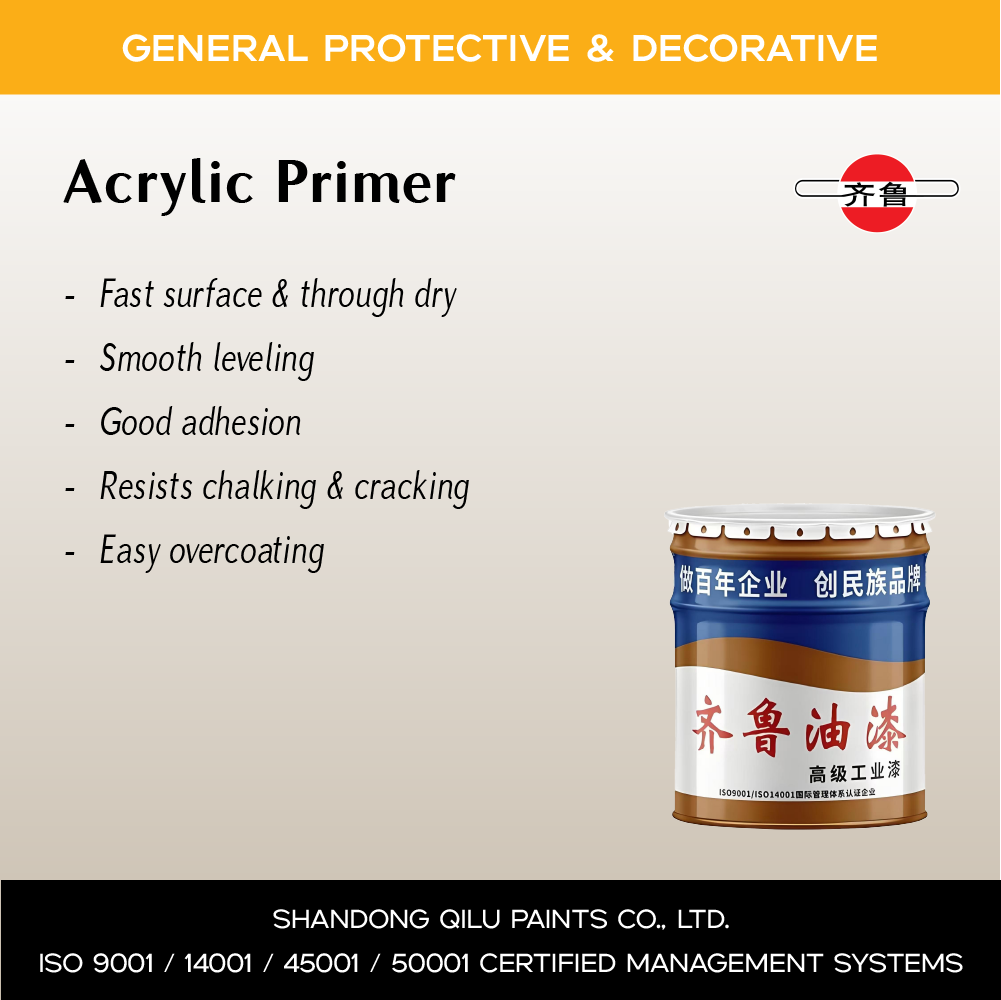
Acrylic Primer
Description
Formulated with copolymers of methacrylic acid and its esters, pigments, active anti-corrosive pigments, additives, and organic solvents. A single-component, fast-drying anti-corrosive primer for ferrous metal substrates where baking is not applicable.
Recommended Uses
- Designed as an anti-corrosive primer for machinery, equipment, and transportation vehicles. Suitable for new construction and maintenance of steel structures in general industrial environments. Recommended as the first coat in acrylic or epoxy-acrylic coating systems.
Best For
- fast-drying industrial finishing
- machinery and equipment
- decorative metal coating
Buyer Benefits
- fast drying
- good decorative finish
- practical for production repainting and maintenance
Key Features
- Fast drying: touch dry ≤ 20 minutes at 23°C
- Smooth, flat finish
- Active anti-corrosive pigments for enhanced rust inhibition
- Resistant to powdering and cracking
- Excellent adhesion to blasted and power-tool cleaned steel
- Good compatibility with acrylic and epoxy topcoat systems
- Single-component, no mixing required
Typical Coating System
Typical acrylic system: compatible primer selected by substrate, followed by acrylic enamel or topcoat.
Technical Specifications
| Product Family | Acrylic |
| Coating Layer | Primer |
| Component System | 1K or ready-to-use system, confirm from current TDS |
| Recommended Use Snapshot | Designed as an anti-corrosive primer for machinery, equipment, and transportation vehicles. Suitable for new construction and maintenance... |
| Typical System | Typical acrylic system: compatible primer selected by substrate, followed by acrylic enamel or topcoat. |
Confirm current TDS/SDS, packaging, shelf life, and destination-market requirements before quotation or shipment.
Request Current TDS/SDSApplication Guide
| Surface Preparation | Remove all rust, mill scale, oil, grease, and loose contamination before application. Abrasive Blasting: Sa2 or Sa2½ recommended for best performance Manual/Power Tool Cleaning: St2–St3 acceptable for general anti-corrosion work After pickling and passivation, ensure substrate surface is neutral (pH 7) before priming Apply primer within 12 hours of rust removal to prevent secondary rusting |
| Application Method | Conventional Spray (recommended): Nozzle diameter: 2.0–3.0 mm Spray pressure: 0.3–0.6 MPa (approx. 3–6 kg/cm²) Airless Spray: Suitable Brush / Roller: Suitable for touch-up and small areas |
Compatible Products
Product FAQ
Can I request the current TDS and SDS for Acrylic Primer?
Yes. Contact the Qilu Paints export team with the product name, destination country, and application environment to confirm current TDS/SDS, packaging, and export requirements.
How should Acrylic Primer be selected for a coating system?
Confirm substrate, exposure environment, required durability, compatible primer or topcoat, and destination-market documentation before quotation or shipment.
What should be checked before applying Acrylic Primer?
Check surface cleanliness, surface profile, ambient temperature, substrate temperature, dew point, and relative humidity before application. Stir thoroughly before use.
How should Acrylic Primer be stored and handled?
Store sealed containers in a cool, dry, ventilated area away from heat, sparks, and direct sunlight. Follow the current SDS for PPE, ventilation, fire prevention, and waste disposal.
What should be checked before applying Acrylic Primer?
Confirm substrate cleanliness, surface profile, dew point, ambient temperature, humidity, and compatibility with the primer or topcoat in the coating system.
How should Acrylic Primer be mixed and applied?
Stir thoroughly before use. For multi-component products, mix base and curing agent according to the current TDS, observe induction time and pot life, and only thin with the recommended thinner.
How should unopened Acrylic Primer be stored?
Store in sealed original containers in a cool, dry, ventilated place away from heat, sparks, and direct sunlight. Confirm shelf life and packaging with the current TDS/SDS before shipment.
What safety precautions are required during application?
Use suitable PPE, provide ventilation, keep away from ignition sources, and follow the current SDS for handling, fire protection, first aid, and waste disposal.
Product Data Source
This product page is generated from Qilu Paints legacy technical product records. Confirm SDS, TDS, export classification, packaging, and destination-market requirements with the sales and technical team before quotation or shipment.
Interested in This Product?
Contact us for detailed technical data sheets, pricing, and customized solutions for your application.